Is it lying to tailor your resume? No — until it is.
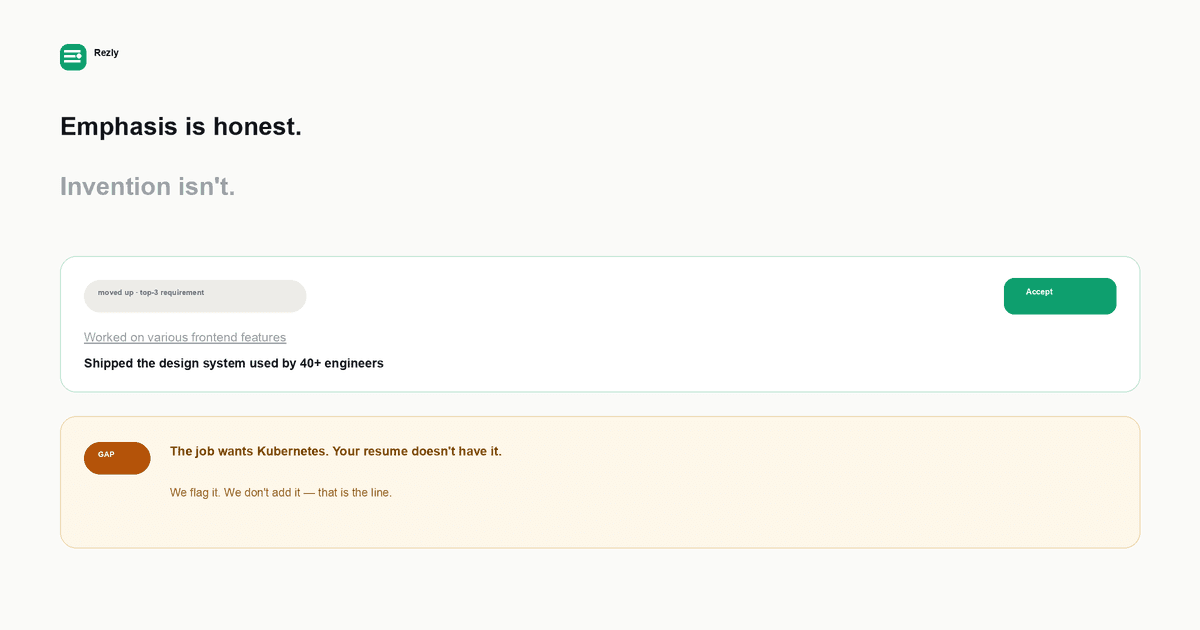
Emphasis is honest. Invention isn't. The line between them is sharper than most advice admits, and there's a simple test for which side you're on.
· 5 min read · Rezly
Is tailoring your resume dishonest?
No, and the discomfort people feel about it usually comes from conflating two different acts. A resume is not a legal record of everything you have ever done; it is a two-page argument for why you fit one particular job, and every version of it already leaves out almost your entire working life. You are not obliged to give equal space to the six months you spent on a project nobody cares about. Choosing which true things to lead with, given who is reading, is what the document is for — the same way you would answer “tell me about yourself” differently in an interview for two different roles without anyone calling it deception. What makes tailoring feel slippery is that the same tools and the same ten minutes can be used for something genuinely dishonest, and the transition between the two is smooth enough that people cross it without noticing.
Where exactly is the line?
Here is a test that resolves almost every case: could you be asked a detailed follow-up question about this sentence and answer it comfortably for two minutes? If yes, you are emphasising. If no, you are inventing. Reordering bullets so the relevant ones come first passes. Rewriting “wrote automated test scripts” as “built test automation” because the posting uses that phrase passes — the underlying work is the same and you can describe it. Adding a framework to your skills list because it appears in the job description fails immediately. Turning “contributed to” into “led” fails, because you will be asked who reported to you. Adding a percentage you never measured fails, and it fails worst of all, because numbers invite exactly the follow-up you cannot answer. The line is not about how much you changed. It is about whether the claim survives contact with a curious interviewer.
Can you get caught lying on a resume?
Routinely, and rarely in the dramatic way people imagine. Background checks catch fabricated degrees and invented employers, and those end offers — sometimes years later, because employment fraud has no statute of limitations in most companies' internal policies. But the far more common version is quiet. An interviewer asks a normal follow-up about something on your page: how did you get that 40%, what was hardest about that migration, what would you do differently. Forty seconds of vagueness later, everyone in the room understands, and nobody says anything. You simply do not progress and never learn why. The damage is worse than the missing skill would have been. A gap you acknowledge is an ordinary hiring conversation — people are hired without every requirement constantly. A claim that collapses under one question retroactively puts every other claim on the page in doubt.
What do you do about a requirement you genuinely don't meet?
Name it, and move the conversation to what you do have. If a posting wants five years and you have three, the resume should show three clearly and lead with the depth that makes those three unusual. If it wants a technology you have never touched, do not add it — instead surface the nearest genuine thing, and say plainly in the cover note that you have not used it but have done the equivalent in another stack. Hiring managers deal with partial matches all day; almost nobody meets every line, because postings are wish lists assembled by committee. What they cannot deal with is discovering the gap in the interview after you implied it was not there. If the gap is a hard credential — a licence, a clearance, a legally required certification — that is the case where the honest answer is to skip the job and spend the evening on a better-fitting one. Our tools will tell you that.
How do you stop an AI tool from crossing the line for you?
Assume it will, and check. A general-purpose model asked to improve a resume optimises for a convincing document, and when the facts run out it fills the gap with what is statistically likely for your job title — a plausible framework, a plausible percentage, a team you never led. It is not deceiving you; completion is what it does. So the tool has to be constrained: allowed to rephrase, reorder and re-emphasise what is already there, and blocked from adding skills, employers, titles, dates or metrics that are not. It also has to show you what it changed. A rewritten resume you did not read line by line is a document you cannot defend, whoever wrote it. That is why every change here appears next to your original with a reason attached, and why requirements your resume cannot support become flagged gaps rather than new bullets.
What should you do before applying to anything?
Spend two minutes deciding whether the job is worth the hour. Pull the requirements out of the posting, rank them by how hard the posting leans on each, and check which ones your resume already evidences. If you cover most of the must-haves, tailor properly and apply. If you miss two of them, the realistic options are a referral, a cover note that addresses the gap head-on, or skipping it. This ordering matters because the scarce resource in a job search is not applications, it is the attention you can give each one. Fifteen deliberate applications beat a hundred generic ones, and the only way to know which fifteen is to check before you write rather than after you are ignored. You can do that free — no account — with the should I apply to this job checker.