Do ATS systems actually reject resumes? Mostly, no.
The 75% statistic everyone repeats has no research behind it. Here's what an applicant tracking system really does with your resume, and what actually filters you out.
· 5 min read · Rezly
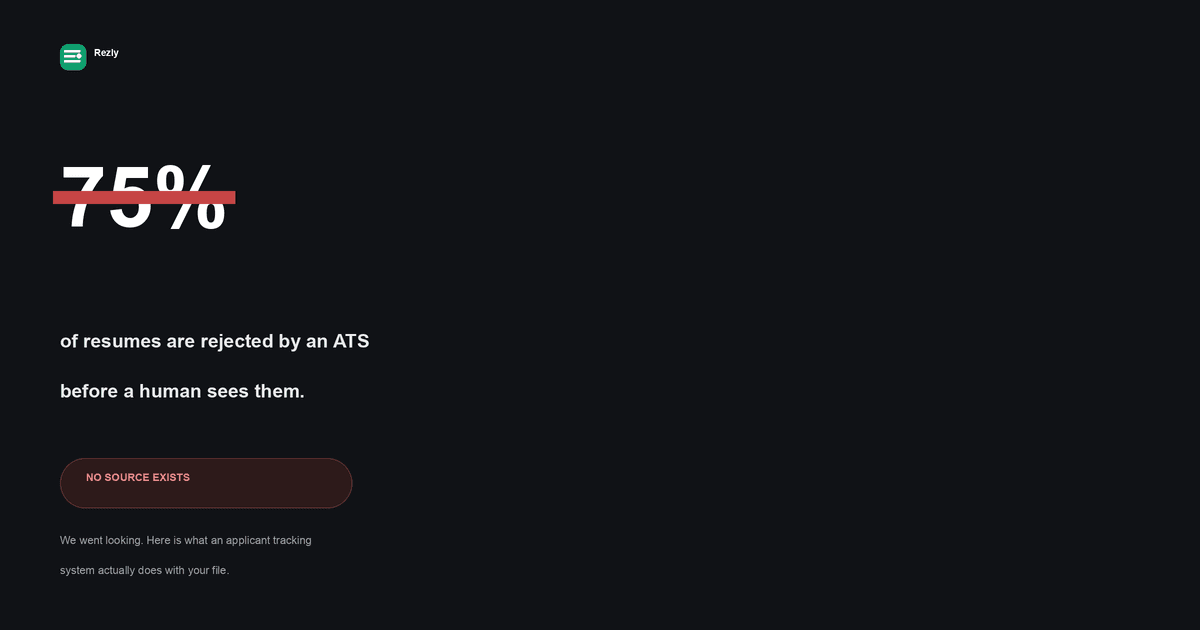
Where did the 75% statistic come from?
You have seen the claim: 75% of resumes are rejected by an ATS before a human sees them. It appears in career advice articles, LinkedIn posts and the marketing of nearly every resume tool, usually with no source attached, and when a source is attached it leads to another article repeating it. There is no study behind the number. It circulates because it is useful to the people repeating it — a statistic that says invisible software is destroying your applications is a very effective way to sell software that claims to beat it. Fear is the business model. That does not mean applicant tracking systems are harmless or that formatting does not matter; both are real concerns, covered below. It means the specific frightening claim is marketing, and you should treat any product that leads with it as telling you something about itself rather than about hiring.
What does an applicant tracking system actually do?
It is a database with a workflow attached. When you apply, the system stores your file, parses it into structured fields — name, contact details, employers, dates, titles, education, skills — and puts the application into a queue attached to that job. Recruiters then search and filter that database: show me candidates with Kubernetes, show me applications from the last week, show me everyone the hiring manager has not reviewed. The system also tracks the stage each candidate is at, schedules interviews, and stores notes so a hiring team can work from one record. What it mostly does not do is form a judgement about you. In the majority of configurations there is no quality score, no threshold, and no automatic rejection based on the content of your resume. It is closer to a filing cabinet with a good search box than to a bouncer at a door.
Do any applicant tracking systems auto-reject candidates?
Some do, but not in the way the myth suggests. Where automatic rejection exists, it is almost always tied to knockout questions the employer configures deliberately: are you legally authorised to work in this country, do you have the licence this role legally requires, will you require sponsorship, do you have the minimum years the role specifies. You answer those in the application form, not in your resume, and the rule fires on your answer. That is a policy decision by the employer, applied consistently, and arguably the fairest part of the process. What is vanishingly rare is a system reading your resume, scoring the prose, and binning it for scoring too low. The practical implication is worth internalising: rewriting your bullets will not rescue you from a knockout question, and answering the form carefully matters more than most of the formatting advice you have read.
So what is actually rejecting your resume?
A person, in about five to twenty seconds. That is the real filter, and it is far more brutal than any software. A recruiter working through a list is scanning for four things: your current title and level, the skills this specific job needs, roughly how much experience you have, and whether the overall shape of your background makes sense for the role. If those four are not obvious near the top of the first page, you are out — not rejected by an algorithm, just not selected by a tired human with sixty more to get through. This is why tailoring works, and why it works for a reason that has nothing to do with beating machines. Moving the relevant parts of a true resume to where they will be seen in the first five seconds is the entire mechanism. Keyword density is not.
What does genuinely break when an ATS reads your resume?
Parsing, and it fails structurally rather than stylistically. The reliable breakers are multi-column layouts, because many parsers read cell by cell rather than left to right and your dates end up attached to the wrong employer; layout tables, for the same reason; text boxes and images with words inside them, which are invisible to a parser, so contact details placed there do not exist as far as the database is concerned; and creative section headings, because parsers use words like Experience and Education to decide which text belongs in which field. The worst case is a scanned resume with no text layer at all: it looks perfect to you and is an empty record to everything else. The consequence is not rejection. It is being unfindable — a recruiter searches for a skill you have, and you do not come back.
What should you fix instead?
Start with structure, because it is quick and the failure is total. One column, standard headings, real text rather than graphics, bullets as actual list items, contact details in the body of the first page rather than the header. That takes ten minutes and removes nearly all the genuine parsing risk. Then spend the rest of your time on the five seconds: make your current title, your most relevant skills and your strongest evidence for this specific job impossible to miss near the top. Mirror the posting's vocabulary where your experience genuinely supports it, because a human skimming finds familiar words faster — not because a robot demands an exact match. Modern systems handle synonyms perfectly well. You can check the structural half free with our free ATS resume checker, which reports only the things it can actually measure.