Naukri resume format: what actually parses in India.
The ATS resume format rules for Indian job portals, which local conventions to drop, and why the photo at the top of your resume costs you more than it gains.
· 6 min read · Rezly
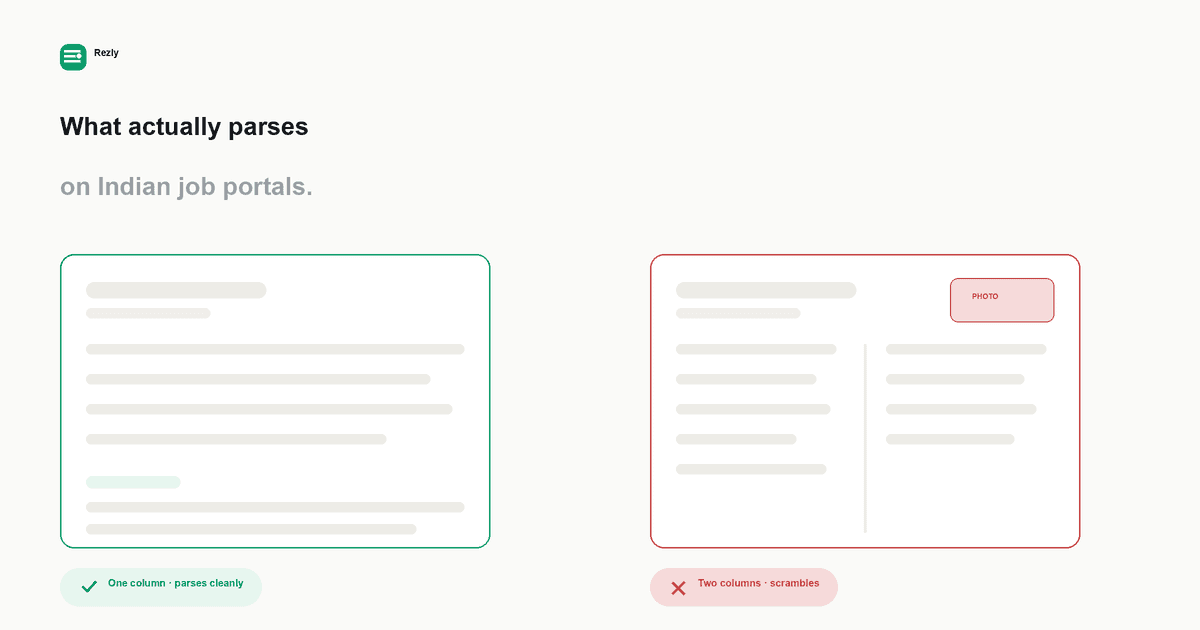
What resume format works for Naukri and Indian ATS systems?
The same plain structure that works everywhere, applied more strictly, because Indian portals put your resume through two passes rather than one. Naukri and similar sites parse your uploaded file to populate a searchable profile, and then employers export or view that profile through their own applicant tracking system. Anything lost in the first pass is gone before the second even starts. So: a single column, no tables holding layout, standard section headings — Experience, Skills, Education, Projects — real text rather than images, bullets as actual list items, and your name, phone number and email as plain text in the body of the first page rather than in a header or footer. A .docx or a text-based .pdf both parse fine; a scanned or exported-as-image file does not, and it is the single most common way an otherwise strong Indian resume ends up as an empty profile.
Should an Indian resume include a photo, age or marital status?
Leave them off unless the employer explicitly asks. The convention of opening with a photograph, date of birth, father's name, marital status, nationality and passport number is still common on Indian resumes and it costs you twice. First, structurally: photos are usually placed in a header or a floating box, which is precisely the part a parser cannot read, and they often push the rest of the content into a second column. Second, practically: that block occupies the most valuable real estate on the page — the top third, where a recruiter spends their first five seconds — with information that has no bearing on whether you can do the job. Multinationals and most tech employers actively prefer resumes without it. Use that space for your current title, your strongest two or three skills for this specific role, and one line of evidence. Keep the photo for the portal profile field, if the portal has one.
How long should an Indian resume be?
One page for the first three or four years, two pages after that, and almost never three. The habit of a four or five page resume listing every project, every training programme and every school-level achievement is a hangover from a time when resumes were read rather than skimmed, and it works against you now. Nobody reads page three. Depth on your two most recent roles is worth more than completeness across eight, and a long tail of thin entries actively dilutes the strong ones. Cut academic detail once you have work experience: your tenth standard percentage stops being relevant the moment you have shipped something. Keep the degree, the institution and the year. If you are early career and genuinely short on work history, projects with real outcomes fill the gap far better than a list of certifications nobody asked about.
Do you need a different resume for Indian and international jobs?
Usually the same resume with a different top third. The structural rules are identical, and a resume built for parsing works on both sides. What changes is context that a foreign reader cannot supply themselves: name the industry rather than assuming the employer is known, spell out the scale — a company recognisable across India may mean nothing to a hiring manager in Berlin, so “fintech processing 2 million transactions a month” carries the weight the brand name would have carried locally. Keep dates in an unambiguous format, since 03/04/2024 is two different days depending on the reader. Drop CGPA conversions and percentage marks that mean nothing outside the Indian system, or state them with the scale. And use the posting's vocabulary, because a recruiter unfamiliar with local job titles is matching on the words in front of them.
What does resume tailoring cost in India?
Most tools in this category are priced in dollars on a monthly subscription, which lands somewhere between ₹1,700 and ₹4,000 a month once converted — a meaningful fraction of a junior salary, charged continuously, for software you need in bursts. That pricing quietly excludes exactly the people running the highest volume of applications. Rezly is bought once instead of monthly: $9 for 15 tailorings, $19 for 60, and $49 for 100 with cover letters, with credits that never expire — roughly $0.60 per tailored resume on the smallest pack, and a pack you buy during one search is still there for the next one. Payments run through a merchant of record that shows the amount in rupees at checkout and handles Indian cards, UPI-backed methods and local tax properly instead of declining them. Scoring a resume against a job description stays free either way, and the full pricing is here.
What should you check before uploading to a job portal?
Run the file through a parser and read what comes out. That single step catches more problems than any amount of formatting advice, because it shows you the version employers actually receive rather than the one your word processor displays. Look for three things: does all the text appear at all, are your job titles and dates still attached to the right employers, and did your contact details survive. If any of those fail, the cause is almost always a column, a table, a text box, or a file exported as an image — fix that before touching a single word of the content. Only once the structure is sound is it worth tailoring the wording to a specific posting. Both halves are free here: the free ATS resume checker for the structure, and the resume job description match score for the fit.